








An AI application is ready for its next release. The technical team has tested it. The business owner wants to proceed. Risk and compliance still need to understand what has changed, which checks were completed and who can approve the remaining risks.
The answers may already exist, spread across a project tracker, test reports and email conversations. Someone now has to bring them together. When the next application reaches the same point, another team repeats the exercise.
This is a useful place to start the business case for an AI governance platform. Its value depends on whether it helps people make sound decisions with less avoidable work. A central register is useful, but the larger benefit comes from connecting that register to assessments, evidence, approvals and ongoing oversight.
Where the work gets easier
Consider an organisation introducing an AI assistant for customer service. Before launch, reviewers need to understand its intended use, the information it accesses, its limitations and the conditions under which an employee must check its answers.
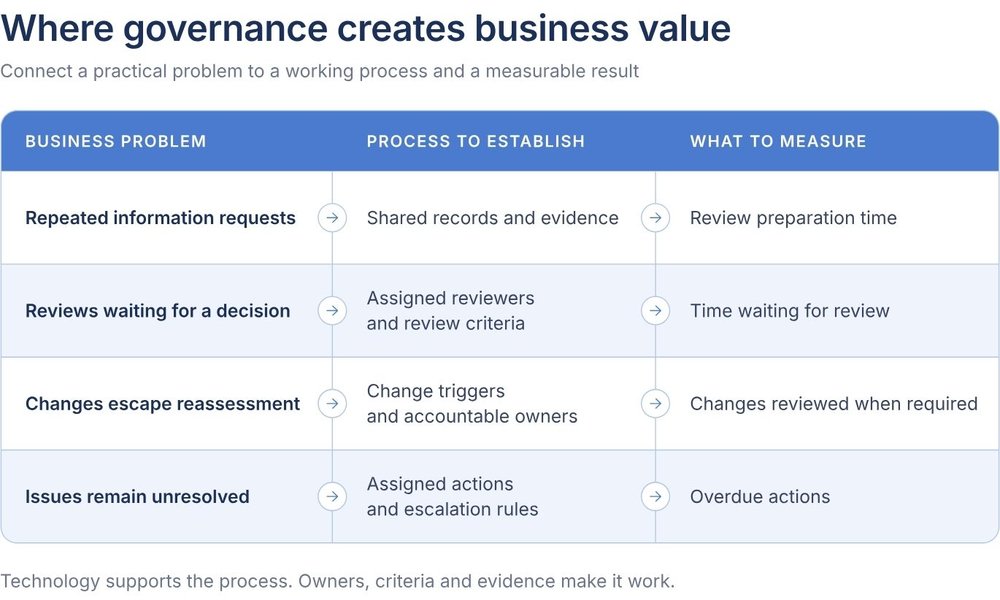
Without a shared process, different functions may ask the business owner for the same information in different formats. Reviewers may work from different versions of a document. A missing decision can leave the whole release waiting.
A governance platform can support a common record, route tasks to the relevant people and keep the evidence behind a decision together. When configured around agreed review criteria, it can also help teams apply different levels of scrutiny to different uses of AI.
The benefit is practical: less time collecting information, fewer repeated requests and a clearer view of what is holding up a decision. Faster approval is useful only if the review remains thorough enough for the risks involved.
Making evidence useful after approval
The customer service assistant is approved for a defined purpose. Later, the team connects it to another source of customer data or gives it permission to take an action that it previously only recommended. The original approval may no longer cover the proposed use.
A useful governance process connects such changes to a decision about reassessment. It records what changed, who reviewed it and whether further testing or restrictions are needed. The platform can support this process, provided the relevant change information reaches it.
The same principle applies to monitoring. A performance alert becomes more useful when someone knows which business process it affects, who must respond and what action is expected. Collecting metrics without establishing those responsibilities leaves the difficult part unresolved.
These records also make subsequent reviews easier. Teams can explain the basis of a decision without reconstructing it from old messages. That supports audit preparation and gives management a more reliable view of unresolved issues.
Choosing capabilities that fit the business
A useful starting point is to define what teams need to do: maintain an AI inventory, assess risks, assign reviews, record decisions and track follow-up actions. These requirements give buyers a basis for evaluating a platform against their own work.
A company may already have model monitoring, change management and enterprise risk tools. The implementation should establish which information is needed from those systems, where decisions are recorded and which integrations justify their cost. Existing processes should be considered before introducing another place to enter the same information.
For the customer service assistant, that could mean connecting evaluation evidence to a governance review and recording the approval conditions. A practical demonstration should show how reviewers receive that evidence, how they record a decision and what happens when the application changes. The organisation can then judge whether the proposed setup solves its problem.
The contribution of accelerators
Software still needs agreed rules and usable content. Teams must decide which risks to assess, what evidence is sufficient and when an issue requires escalation.
This is where governance accelerators can help. A risk atlas provides a starting vocabulary. A control library can connect a risk to a proposed safeguard and its evidence requirements. Assessment templates and workflow designs can give teams a consistent starting point instead of asking every project to invent its own approach.
For the customer service assistant, a control library might provide a starting point for addressing inaccurate answers. The team would still need to decide when human review is required, how to test the safeguard and who checks that it remains effective. These decisions can then be reflected in assessment questions, assigned tasks and evidence requirements within the platform.
The value of an accelerator depends on how much useful work it saves. A template that requires extensive rewriting offers little advantage. Each asset needs to fit the client's business, risk criteria and operating processes, and remain current as these change.
Where to start- Building a business case that can be tested
Start with a process that is causing a recognisable problem. Perhaps reviews take too long because evidence is hard to find. Perhaps different business units repeat the same assessment. Or perhaps nobody can reliably identify which approved applications have overdue actions.
Start small and measure how the process works today. Track the time needed to prepare a review, requests for missing information and the share of overdue actions. Check review quality too: a faster process is not better if important questions go unanswered.
Compare the benefits with the full cost, including licensing, setup, integrations, training and the people needed to maintain records and processes. If your organization has only a few straightforward AI uses, better use of existing tools and clearer responsibilities may be enough. A dedicated platform must be worth the extra cost.
Nemko Digital can help assess where governance work is getting stuck and define a practical first scope, including the role of technology and reusable governance assets. A useful starting conversation is to walk through one AI use case and identify which decisions, handovers and evidence requirements need to work better.

AI Author Experts
 Özgür M. Kalay
, PMP, PMI-ACP, is an experienced project management leader and entrepreneur with a background in SaaS, technology, and global PMO operations. He focuses on the practical applications of AI in project delivery, risk management, and workflow automation, helping organizations turn complex challenges into actionable solutions.

Hans-Petter Dalen
Hans-Petter Dalen is Global Sales Director at Nemko Digital, bringing extensive experience in sales and business leadership from his career at IBM across Europe and EMEA. He focuses on AI for business, AI governance, and helping organizations build trust and security into the adoption and scaling of AI technologies.