

.webp)



Situation
An electric vehicle charging provider was preparing to expand its public charging services across Europe. Its existing privacy governance framework included policies, procedures, and operational documentation covering the complete lifecycle of personal data processing.

The organization had already established controls across areas such as Records of Processing Activities, data-flow mapping, data classification, Data Protection Impact Assessments, access control, incident response, and data subject rights. However, increasing regulatory scrutiny and the General Data Protection Regulation’s strict requirements created uncertainty about whether this foundation was sufficiently complete, consistent, and mature.
The organization engaged Nemko Digital to independently assess its privacy governance framework against GDPR requirements and current regulatory expectations. The objective was to identify practical improvements that would strengthen accountability, mitigate privacy risk, and support continued operations and expansion in the European market.
Challenges

The organization already had a broad set of privacy policies and procedures. It needed independent assurance that those controls collectively met GDPR requirements and reflected current regulatory expectations.

Policies, data inventories, diagrams, assessments, and response procedures had to operate as one coherent framework. Inconsistencies or gaps between documents could create ambiguity and weaken implementation.
.svg)
Written controls needed to reflect how personal data was actually classified, accessed, processed, protected, and managed throughout the EV charging platform’s operations.

The review needed to identify areas where responsibilities, decision-making authority, or governance processes were not sufficiently clear to support reliable execution at scale.

Certain processing activities took place outside the European Union. The organization needed greater clarity on the application of GDPR Chapter V and the governance measures required to manage international transfer risk.
Key Metrics
Nemko Digital evaluated the privacy documentation as an integrated governance framework rather than as a collection of standalone policies. This approach gave the organization a clearer view of existing strengths, documentation gaps, operational inconsistencies, and priority improvements
.The assessment covered ten categories of documentation, seven established governance areas, three complementary control perspectives, and one international data-processing model.

Categories of privacy policies, procedures, records, and supporting documents reviewed
Established governance areas assessed across the existing privacy framework
Control perspectives evaluated across legal, organizational, and technical measures
International processing model independently assessed for GDPR requirements and transfer risk
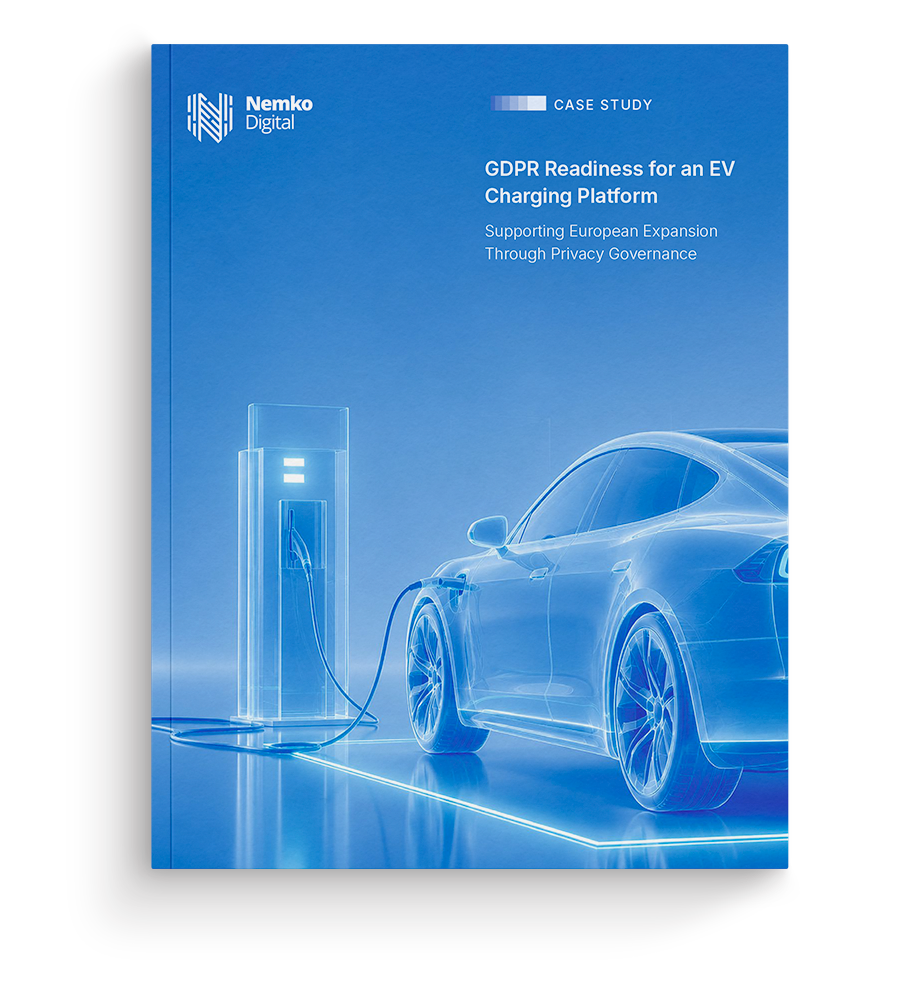
Download the Full Case Study
Get the complete case study as a PDF for offline reading, sharing with your team, and reference. It includes the privacy documentation reviewed, assessment approach, international-processing considerations, recommendations, and value delivered.