

.webp)




Navigating the New EU Product Liability Directive: A Strategic Guide for Innovators
New EU Product Liability Directive: What to Know Now
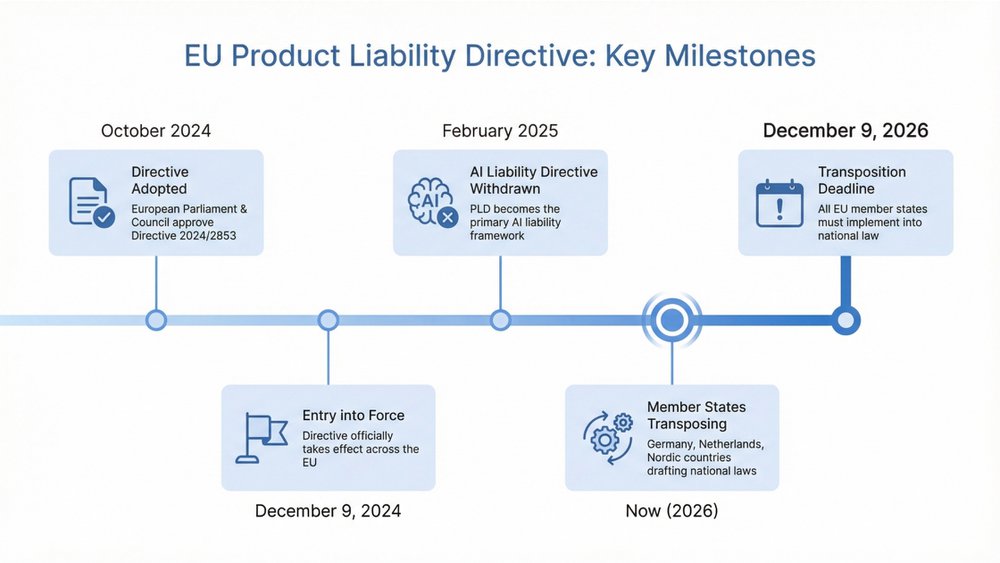
The European Union has modernized its product liability rules for the first time in four decades. The new EU Product Liability Directive (PLD) replaces the 1985 framework, establishing a new standard for accountability in the digital age. With the December 2026 transposition deadline approaching, Member States have already begun the process of implementing these new rules, making this a critical time for companies placing products on the EU market to prepare.
A New Era for Product Liability in Europe
Effective from December 9, 2024, with a transposition deadline for member states of December 9, 2026, Directive (EU) 2024/2853 overhauls the EU's strict liability regime. Its primary goal is to provide legal clarity for businesses and ensure a high level of consumer protection against defective products, adapting the law to the challenges of software, Artificial Intelligence (AI), and the circular economy.
The directive's significance was amplified following the withdrawal of the separate AI Liability Directive proposal in February 2025. This positions the new PLD as the central piece of EU legislation governing civil liability for damages caused by AI systems and other digital products, making it a critical regulation for technology companies to understand. Organizations already navigating the broader EU regulatory landscape should pay close attention to how the PLD intersects with existing obligations.
Who and What Does the New Directive Cover?
The new regulation significantly broadens both the definition of a “product" and the range of economic operators who can be held accountable for damages.
An Expanded Definition of "Product"
The directive's scope now explicitly includes all movables, whether or not they are integrated into other items. The most critical expansion is the inclusion of digital elements, such as:
- Software: This encompasses operating systems, firmware, AI systems, and standalone software, including those provided via a Software-as-a-Service (SaaS) model.
- Digital Manufacturing Files: Such as the design files used for 3D printing.
- Related Digital Services: Any digital service that is integral to a product's function, where its absence would prevent the product from working correctly.
A Wider Net of Liable Parties
Liability is no longer confined to the traditional manufacturer. Under the new rules, a claim can be brought against a wider array of economic operators, including:
- Manufacturers and component manufacturers.
- Providers of software and related digital services.
- Any person or company that substantially modifies a product.
- Importers, authorised representatives of non-EU manufacturers, and fulfilment service providers.
- Distributors and online marketplace operators under certain conditions.
This ensures that for almost every product on the EU market, there is a liable party based within the Union that a consumer can hold accountable. For companies developing AI-embedded products, this expanded scope demands a thorough review of supply chain responsibilities.
Understanding the Key Changes in the EU Product Liability Directive
The new PLD introduces several claimant-friendly provisions that fundamentally alter the risk landscape for businesses. These changes are designed to address the complexities of modern digital products and make it easier for consumers to receive compensation.
| Evidence Disclosure | Claimants can petition courts to order companies to disclose necessary evidence, addressing the information asymmetry between consumers and manufacturers of complex products. |
| Extended Liability Period | The standard 10-year liability period can be extended to 25 years for personal injuries with slow-emerging symptoms (latent health injuries). |
The Compliance-Liability Nexus: A Strategic Imperative
One of the most profound changes introduced by the new PLD is the direct link it creates between regulatory compliance and liability risk. A rebuttable presumption of defect can arise if a claimant demonstrates that the product failed to comply with mandatory safety requirements, including those under the General Product Safety Regulation (GPSR) or the landmark EU AI Act.
In order to reinforce the close relationship between product safety rules and liability rules, non-compliance with such requirements should also result in a presumption of defectiveness. — Recital 46, Directive (EU) 2024/2853
This means that robust technical documentation and a demonstrable history of compliance with other key regulations are no longer just about market access, they are now essential components of a company's litigation defence strategy. For manufacturers of AI-enabled products, adherence to the AI Act's requirements for risk management, data governance, and post-market monitoring will be a critical factor in mitigating liability exposure under the PLD.
Navigate the Regulation with Confidence: Strategic Steps for Your Business
The transition period until December 2026 offers a critical window for businesses to adapt. Proactive preparation is essential to mitigate risk and turn compliance into a competitive advantage. Key strategic steps include:
- Conduct a Gap Analysis: Systematically review your product portfolio, supply chain agreements, and internal processes against the new directive's requirements.
- Strengthen Governance and Documentation: Establish evidence-ready controls and meticulous records for the entire product lifecycle. This documentation is your first line of defence.
- Review and Update Contracts: Ensure that agreements with all supply chain partners clearly define roles, responsibilities, and liabilities in alignment with the new framework.
- Embrace Safety-by-Design: Embed safety, cybersecurity, and regulatory compliance into the earliest stages of product development. For guidance on this, exploring established EU harmonized standards is a crucial step.
Partner with Nemko Digital to Ensure Compliance and Build Trust
The new PLD creates a more complex legal environment, but it also provides a clear roadmap for building trustworthy and resilient products. By embracing the principles of safety, transparency, and accountability, businesses can not only ensure compliance but also strengthen consumer confidence in a digital world.
Navigating this landscape requires deep regulatory and technical expertise. Nemko Digital's team of experts can help you understand your obligations, assess your risks, and implement the governance frameworks needed for success. Contact us today to learn how we can support your journey toward confident compliance.