
.webp)



Situation
Samsung Electronics, the global leading manufacturer of consumer electronics and home appliances, was developing an advanced remote support system for connected home appliances. The system enables authorized technicians to remotely diagnose, troubleshoot, and resolve issues, significantly improving service efficiency while reducing the need for on-site interventions. By analysing operational data, the system can detect potential issues early, including equipment malfunctions, abnormal usage patterns, and maintenance needs.

By enabling remote diagnostics and software adjustments, the system delivers faster resolution times, lower operational costs, and improved customer experience. At the same time, remote access to household appliances introduces new requirements for security, human oversight, transparency, and accountable AI governance. With regulatory frameworks such as the EU AI Act emerging, Samsung Electronics recognized that demonstrating trustworthy and well-governed AI is becoming a prerequisite for scalable deployment and continued market access. To proactively address these requirements and strengthen trust with customers, partners, and regulators, Samsung Electronics pursued Trust Mark certification.
Challenges

Waiting for the full regulatory and standards landscape to mature would delay innovation. The organization needed to demonstrate trustworthiness proactively.
.svg)
Organizations must make design and governance decisions today while the final compliance frameworks, like the EU AI Act, are still being defined.

Samsung Electronics needed a certification approach capable of demonstrating credible and internationally relevant assurance for regulators and global partners.

Achieving certification required translating existing technical practices into structured documentation and evidence that could be independently assessed.

The process required aligning engineering, security, governance, and operational teams around a shared understanding of the Trust Mark requirements.
Key Metrics
Through an independent assessment conducted by Nemko Digital and the Korean Standards Association (KSA), Samsung Electronics established a structured governance framework covering risk management, data practices, human oversight, and lifecycle monitoring.
Beyond certification, the initiative created a scalable foundation for deploying AI across a broader connected product portfolio, reducing future compliance friction and strengthening trust with customers, partners, and regulators.

Countries where the AI-enabled service monitors appliance performance
Risk categories defined by the AI Trust Mark (aligned with EU AI Act)
Potential increase in sales performance from well- communicated trust marks
Repeatable model established for governing AI-driven services at scale
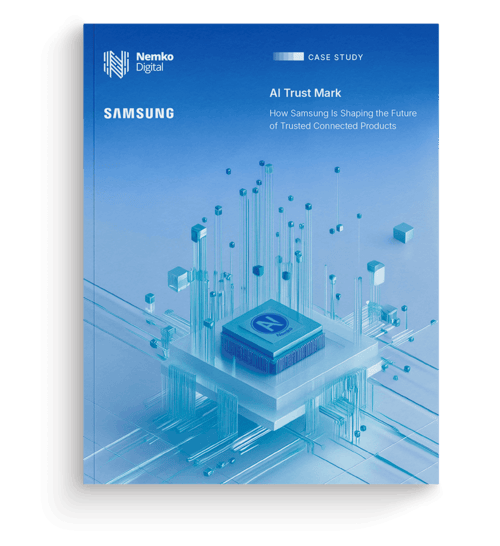
Download the Full Case Study
Get the complete case study as a PDF for offline reading, sharing with your team, and reference. Includes all sections, detailed analysis, and key insights.