


Skip to content
About us

About
Nemko Digital Learn about us here

careers-2

Careers
Contribute towards responsible AI

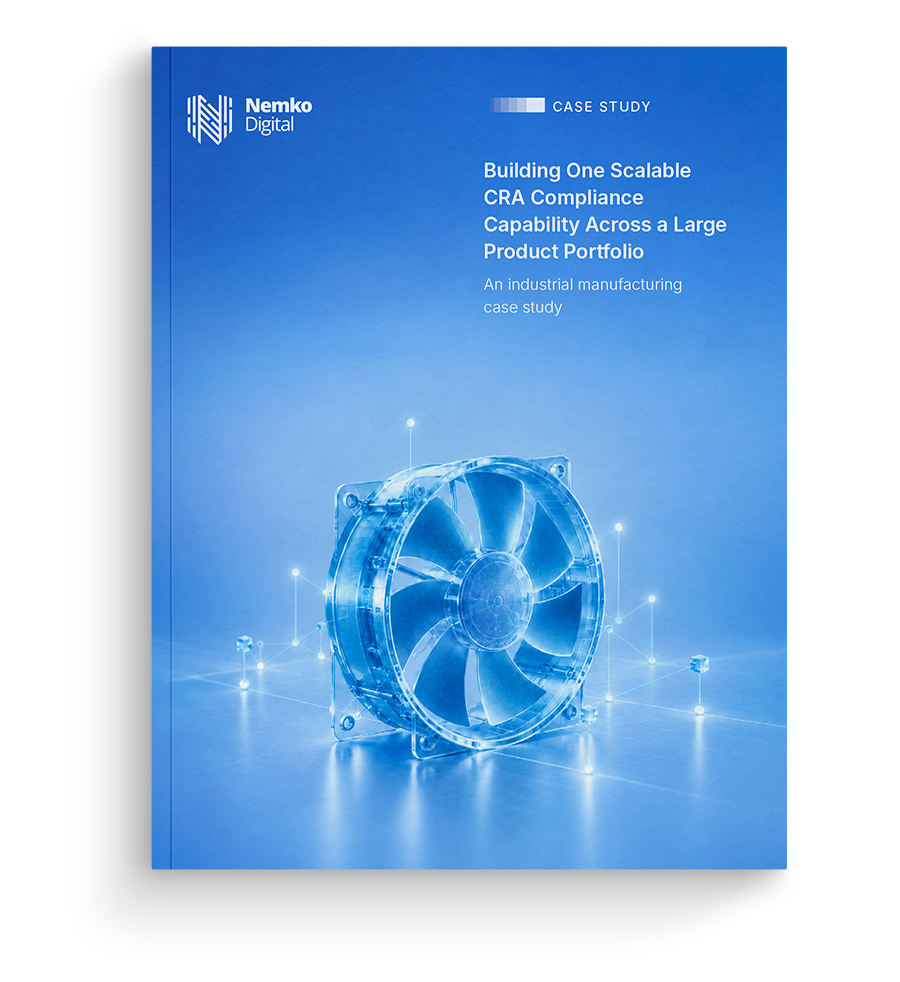
Building One Scalable CRA Compliance Capability Across a Large Product Portfolio

How an industrial manufacturer built a shared CRA compliance model for more than 20,000 products.

Situation

A world-leading manufacturer of ventilation and connected control technologies needed to turn the EU Cyber Resilience Act into a practical way of working across more than 20,000 products. Its international portfolio includes fans, embedded firmware, connected gateways, control software, and digital monitoring solutions, each with different software, connectivity, and deployment characteristics.

candle-2

Customers and partners were increasingly asking about CRA compliance. Internally, business units and technical teams managed product information, responsibilities, and evidence separately. The organization needed a common baseline that supported central governance while allowing divisions to address their own product contexts and levels of cybersecurity maturity.

Existing processes covered corporate IT incidents such as phishing and malware, but product-security incident prevention and response remained gaps. Nemko Digital helped connect product classification, vulnerability handling, reporting, ownership, employee training, and evidence within one scalable program.

Challenges

01.
Layer_1
Portfolio scale and diversity

More than 20,000 products had different software, connectivity, field-access, and deployment profiles, making a shared compliance approach essential.

02.
Layer_1 (1)
Uneven cybersecurity maturity

Some workstreams already followed basic security practices, while others needed foundational guidance, clear owners, and evidence structures.

03.
Fragmented-ownership
Consistent regulatory interpretation

Teams needed a repeatable way to determine CRA scope, product category, conformity route, and reporting obligations.

04.
Decision-paralysis
Fragmented response paths

Vulnerability intake, escalation, reporting, remediation, and user communication were not yet connected through one end-to-end process.

05.
Stalled-go-live-decisions
Central oversight with local ownership

The organization needed consistent governance without losing the flexibility for divisions to implement controls in their own product contexts.

Our Approach & Solution

The program began with an onsite headquarters workshop bringing together product, engineering, IT, legal, compliance, and security stakeholders. Nemko Digital mapped CRA obligations to the manufacturer's workflows, assessed the current state, and established a roadmap. Practical applicability and categorization decision trees helped teams determine scope, identify likely conformity routes, and flag products needing deeper validation. The assessment placed the portfolio in the CRA default-category self-assessment route.

Nemko Digital then designed a CRA Vulnerability Reporting Standard, adapting the company's existing IT security standards to product-security and CRA requirements. The standard defined roles, decision rights, escalation paths, coordinated vulnerability disclosure, public reporting channels, and Article 14 reporting logic. It also covered 24-hour, 72-hour, and final-report workflows for the ENISA Single Reporting Platform, combining central governance with workstream-level ownership.

The work was integrated into the client's existing version-control, documentation, collaboration, and secure-access environments. Hands-on sessions established consistent vulnerability and incident records covering affected products and components, impact, exploitation status, evidence, remediation, reporting milestones, and user communication. Workshops, tabletop exercises, and reporting-path rehearsals began testing whether the roles, decisions, and evidence would work under time pressure.

Consolidated records exposed gaps in monitoring, ownership, evidence quality, escalation, and remediation tracking. They also provided practical input for product cybersecurity risk assessments and continued work toward the broader CRA requirements applying in 2027. A parallel EU Data Act work package aligned governance, resources, and timelines while keeping each regulation's scope and deliverables separate.

01.
Discover & assess
02.
Scope & classify products
03.
Define governance & ownership
04.
Design vulnerability reporting
05.
Train teams & build evidence
06.
Test & improve processes

Key Metrics

The program established one shared CRA compliance model that the manufacturer can apply across its large and varied product portfolio. Structured decision logic, clear ownership, and traceable records reduced reliance on local interpretation and connected central oversight with day-to-day work.

The reporting standard addresses the obligations applying from September 2026, while the broader program provides a foundation for continued product-compliance work in 2027. The client is extending the methods to new product families and strengthening lifecycle capabilities through testing, training, and continuous improvement.


trend-up
20,000+

Products in the portfolio supported by the shared CRA model

trend-up
1

Common CRA baseline connecting governance and product workstreams

trend-up
24 / 72 hours

Early warning and notification milestones addressed in the reporting workflows

trend-up
2027

 Broader CRA product-compliance requirements the program is preparing for
Value Delivered

01.

One scalable baseline with clear accountability: A reusable CRA model connected central governance with workstream ownership, defined escalation paths, and evidence responsibilities across more than 20,000 products.

02.

Faster, more consistent decisions: Structured applicability, categorization, risk, and reportability logic reduced reliance on ad hoc interpretation and gave teams a common basis for action.

03.

Operational reporting readiness and traceable evidence: Processes and templates connected vulnerability intake, rapid triage, authority notification, remediation, and user communication. Records linked decisions, controls, timestamps, notifications, and remediation activity in a traceable compliance model.

04.

Practical adoption and cross-regulatory efficiency: Guidance fit the client's existing tools and workflows rather than becoming a stand-alone framework. A parallel EU Data Act work package aligned governance, resources, and timelines while preserving separate scope and deliverables. The client continues to strengthen lifecycle capabilities, training, metrics, and management review toward full CRA compliance in 2027.

building-one-scalable

Download the Full Case Study

See how Nemko Digital helped an industrial manufacturer connect product classification, vulnerability reporting, governance, and evidence across more than 20,000 products. Download the complete case study for the approach, outcomes, and next steps toward CRA compliance.