

.webp)



.jpg?width=300&name=Radio%20Equipment%20Directive%20(RED).jpg)
Radio Equipment Directive: Navigating the Cybersecurity Landscape
The Radio Equipment Directive is now enforced. Learn what RED's cybersecurity mandates mean for your radio products and how to stay compliant in 2025 and beyond.
Understanding the Radio Equipment Directive Architecture
The Radio Equipment Directive 2014/53/EU establishes the regulatory foundation (including key legal definitions, scope categories, and equipment classes) for placing radio equipment on the single market and obtaining the RED CE mark. Its core objective is to ensure that the proliferation of connected devices does not compromise network integrity, user privacy, or financial security—while also reducing harmful interference and preventing misuse of the radio interface.
The scope of the directive is expansive. It covers everything from consumer electronics like smartphones and smart TVs to industrial IoT sensors and wearable technology, including Wi-Fi equipment and other connected radio products. While medical devices and aviation equipment are largely excluded (or may be governed by other regulations), the directive places particular emphasis on internet-connected devices, childcare equipment, and smart toys. For these categories, the European Commission has made cybersecurity an absolute prerequisite for CE marking. Meaning RED compliance and the required RED certification pathway must be clear before a product can carry the RED CE mark.
Key Cybersecurity Obligations and EN 18031 Restrictions
The 2025 update introduced three critical pillars of cybersecurity (often described as explicit cybersecurity obligations), supported by the EN 18031 harmonized standards. Manufacturers must integrate these requirements into their product development lifecycles to maintain market access and demonstrate full compliance.
1. Network Protection and Integrity (Article 3.3d)
Devices must be engineered to prevent harm to electronic communication networks. This means eliminating default passwords, securing open communication ports, and implementing cryptographic checks for firmware updates. The goal is to ensure that devices cannot be hijacked to launch Distributed Denial of Service (DDoS) attacks or otherwise degrade network performance.
2. Data Privacy and Protection (Article 3.3e)
Aligning closely with GDPR principles, the directive mandates privacy-by-design. Devices must incorporate safeguards to protect the personal data of users. This requires data minimization, robust access controls, and end-to-end encryption for data both in transit and at rest. Transparency in data handling is no longer optional; it is a fundamental requirement for compliance.
3. Fraud Prevention (Article 3.3f)
For devices that enable the transfer of money or virtual currency, robust fraud prevention mechanisms are required. This includes strong user authentication, such as multi-factor authentication (MFA), and hardware-level security like secure boot processes. These measures ensure the integrity of digital transactions and protect users from financial exploitation.
| RED Article | Core Focus | Key Manufacturer Obligation | Harmonized Standard |
|---|---|---|---|
| 3.3(d) | Network Integrity | Secure default configurations and firmware updates | EN 18031-1 |
| 3.3(e) | Data Privacy | End-to-end encryption and data minimization | EN 18031-2 |
| 3.3(f) | Fraud Prevention | Strong user authentication and secure boot processes | EN 18031-3 |
The Conformity Assessment Challenge
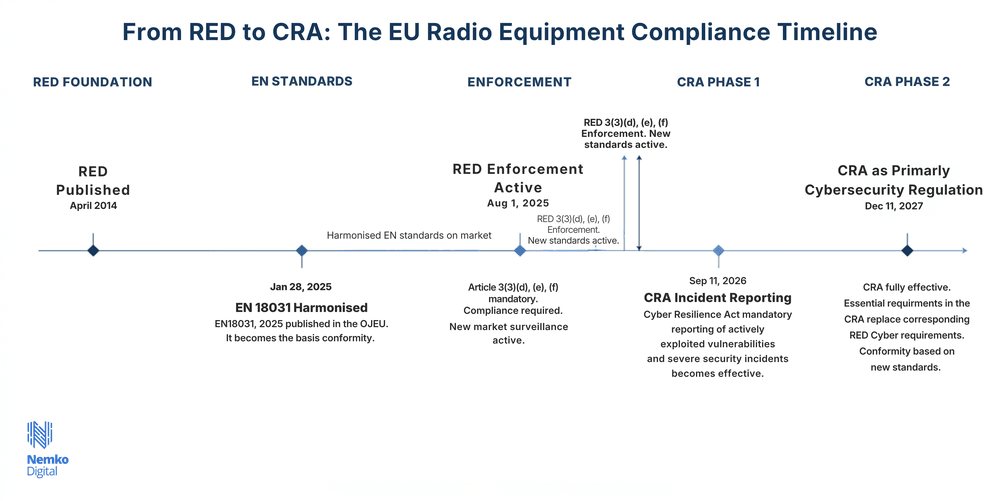
While the EN 18031 standards were published in the Official Journal of the European Union (OJEU) in January 2025, they were harmonized with restrictions (in conjunction with the broader RED regulatory framework and alignment work with bodies such as CENELEC). If a product triggers any restricted clause—such as allowing users to bypass password creation, lacking parental access controls, or relying on a single method for secure updates involving financial assets—the standard is not considered harmonized for that application. In these cases, manufacturers cannot rely on self-declaration and must engage a Notified Body for certification—an approach some organizations also pair with international routes such as the CB Scheme under IECEE as part of their worldwide regulations strategy.
The Strategic Implications: From RED to CRA and the AI Act
The August 1, 2025 deadline has passed, and market surveillance authorities across EU member states are actively enforcing compliance across internet-connected radio devices and other radio products. The UK Government and EU regulators have made it clear that non-compliance results in severe consequences, including product recalls, border seizures, and fines of up to 4% of annual global revenue.
However, viewing the Radio Equipment Directive solely as a regulatory burden misses the broader opportunity. In an era where cyber threats are escalating, verified security is a powerful market differentiator. Organizations that proactively embrace these standards can build deeper digital trust with their customers and partners.
Compliance should be viewed as a foundational element of a broader AI governance pillar. This is especially critical following the January 2026 development where the EU AI Act explicitly listed RED as critical product safety legislation. Radio devices using AI for cybersecurity functions (e.g., machine learning for intrusion detection) may now be classified as "High-Risk AI Systems," triggering a "Double Lock" conformity assessment requiring compliance with both RED and the AI Act.
Furthermore, RED compliance is merely the first step. The Cyber Resilience Act (CRA) entered into force in December 2024, introducing a broader framework that applies throughout the entire product lifecycle. Key upcoming dates include:
- September 11, 2026: Mandatory reporting obligations begin for actively exploited vulnerabilities and severe incidents.
- December 11, 2027: The CRA fully replaces the cybersecurity provisions of RED. Delegated Regulation (EU) 2022/30 will be repealed, and EN 18031 standards will no longer provide a presumption of conformity.
By integrating RED requirements early in the design phase, manufacturers can streamline their path to market, simplify evidence collection for the RED CE mark, and future-proof their products against the CRA. This proactive approach is essential for building AI trust in electronics.
Navigate the Regulation with Confidence
The transition from the Radio Equipment Directive to the Cyber Resilience Act requires technical precision and strategic foresight. Waiting until the December 2027 deadline approaches risks supply chain disruptions and market exclusion. Early testing, gap analysis, and alignment with emerging CRA standards are critical steps to ensure your products remain compliant and competitive—including cybersecurity, electromagnetic compatibility, and (where applicable) safety - human exposure to electromagnetic fields (often assessed against standards such as EN 50371) as part of a complete technical file.
Nemko Digital provides the expertise and verification necessary to turn regulatory requirements into a competitive edge. Our comprehensive approach to product regulation in the age of embedded AI ensures that your devices meet the highest standards of security and privacy. Where third-party assessment is required, organizations may also seek additional test support (e.g., RED testing -) as part of their overall conformity assessment plan.
Contact Nemko Digital today to secure your market access and build lasting trust in your connected products.