

.webp)



Digital Markets Act (DMA)
Understand the Digital Markets Act, recent EU enforcement actions, and what digital businesses must do to stay compliant.
The Digital Markets Act is the EU rulebook designed to make digital markets fairer and more contestable by imposing ex ante obligations on the largest platform gatekeepers. Together with the DSA (Digital Services Act), it is part of the EU’s broader push in the digital sector. Going toward a level playing field, fair practices, safe services, and digital sovereignty aligned with eu values. For regulated businesses, it is now a practical operating framework that shapes app distribution, data access, interoperability, and platform conduct across the EU.
What the Digital Markets Act is
The DMA was adopted to address gatekeeper power in core platform services such as search engines, app stores, messenger services, operating systems, social networks, browsers, virtual assistants, cloud services, and online advertising. It targets so-called gatekeepers and other digital gatekeepers among the largest digital companies with dominant market power and significant impact on the internal market, including online advertising services, online marketplaces, and other major online service providers. The European Commission says the DMA complements, but does not change, EU competition rules, and the Regulation itself is framed to support the proper functioning of the internal market by laying down harmonised rules for fair and contestable digital markets.
In practice, DMA policy and DMA enforcement sit primarily with the Commission. While national competent authorities play a more central role in enforcement architectures. Under related regimes like the DSA and sectoral rules for digital services providers (including areas such as disinformation and platform accountability).
Digital Markets Act scope: who it applies to
The DMA does not apply to every digital business. It applies to gatekeepers: large digital platforms (and other large online platforms in the gatekeeper category) that provide one or more core platform services and act as important gateways between business users and end users. The Commission’s listed on 13 May 2024 the gatekeeper portal . Seven designated gatekeepers and 23 designated core platform services, including Alphabet, Amazon, Apple, ByteDance, Meta, Microsoft, and Booking.com. These are widely seen as the major gatekeepers in the EU’s platform economy.
Designation is based on scale, gateway importance, and durability using defined objective criteria set in the Regulation (including indicators such as user reach and, in context, market share and entrenched position). The Commission’s 2022 DMA communication described the key gateway threshold as more than 45 million monthly active end users in the EU and more than 10,000 yearly active business users in the EU. Alongside the other quantitative and qualitative criteria set in the regulation. The underlying theory is that gatekeepers susceptible to leveraging gatekeeper power can tilt access conditions in ways that harm competition and contestability, especially for smaller EU businesses.
Core Digital Markets Act obligations
The DMA’s obligations are practical and operational, not abstract. The table below is a publication-ready summary of the main compliance themes (covering app ecosystems, messaging, search, online advertising services, and other core platform services that can shape distribution for any digital product).
| Pillar | Requirement | Strategic Impact (2026 Context) |
|---|---|---|
| App distribution and steering | Gatekeepers must allow developers to inform users about better offers outside the app store, and they must allow alternative app distribution channels in scope. | Reduces dependence on one distribution channel and creates room for lower-friction offers. |
| Interoperability | Gatekeepers must allow third parties access to the same operating-system hardware and software features available to their own services, subject to the DMA framework. | Opens ecosystems to connected devices, alternative services, and deeper integration. |
| No self-preferencing | Gatekeepers may not unfairly favor their own services in rankings or presentation. | Affects search, shopping, booking, app stores, and other surface areas where defaults and ranking matter. |
| Data access and portability | The DMA gives business users and end users stronger rights around data access and portability. | Improves switching, multi-homing, and portability of user relationships. |
| Data protection alignment | The DMA and gdpr are complementary, but they have different purposes and scopes; the Commission and EDPB have been working on joint guidance. | Compliance teams must align competition, privacy, and product decisions rather than treating them separately, especially where personal data is involved. |
Enforcement and timeline
The DMA has moved from legislative design to active enforcement. Its timeline is straightforward and important for publication readers, including the Commission’s ability to launch a market investigation where needed to assess compliance, systematic non-compliance, or whether additional services should fall within scope.
| Date | Significance | Impact on Digital Strategy |
|---|---|---|
| 14 September 2022 | The Regulation was adopted. | This is the legal starting point of the DMA framework. |
| 1 November 2022 | The DMA entered into force. | The law became legally effective. |
| 2 May 2023 | The DMA became applicable. | Notification and designation processes started in earnest. |
| 6 September 2023 | The Commission designated the first six gatekeepers. | The enforcement regime moved from theory to implementation. |
| March 2024 | The first designated gatekeepers became subject to the substantive obligations in Articles 5, 6, and 7. | This is when operational compliance obligations became fully visible in practice. |
| 23 April 2025 | The Commission fined Apple and Meta for DMA breaches. | Confirms that the DMA’s penalty regime is being used in live enforcement. |
| 3 July–24 September 2025 | The Commission ran the first DMA review consultation. | The review now includes feedback on the AI sector and the DMA’s effectiveness. |
| 13 November 2025 | The Commission opened an investigation into Google’s demotion of publishers’ content in search results. | Shows continuing focus on self-preferencing, fairness, and access conditions in search. |
| 28 April 2026 | The Commission published the first DMA review report. | The Commission says the DMA remains fit for purpose and is already having positive effects. |
Penalties
The Commission can impose fines of up to 10% of a company’s total worldwide annual turnover, or up to 20% for repeated infringements. It can also impose periodic penalty payments of up to 5% of average daily turnover.
Strategic implications for digital businesses
The first DMA review matters strategically. The Commission’s 2026 review materials say the Regulation remains fit for purpose, has already produced positive effects for businesses and users, and should continue to be enforced rigorously while the Commission explores how the DMA applies to AI and cloud computing, areas that intersect with other “new law” initiatives, including the EU AI Act as the first comprehensive AI law.
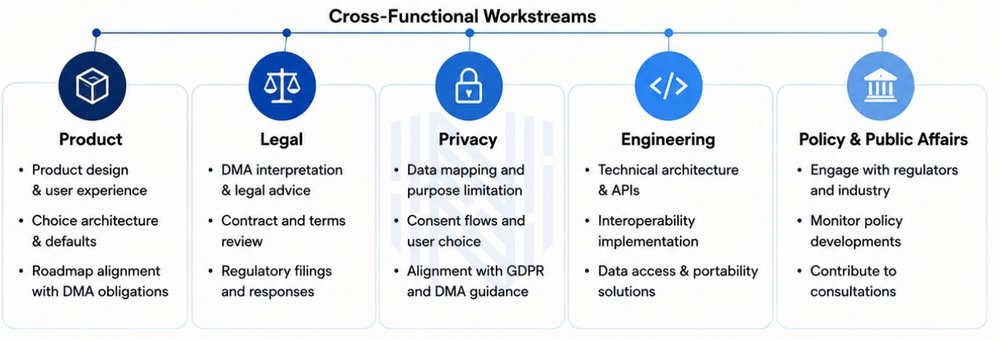
For gatekeepers, DMA compliance is not just a legal exercise. It is a product, data, commercial, and governance redesign project. Teams need to review ranking logic, app distribution rules, steering restrictions, interoperability roadmaps, consent flows, and data-access procedures together. As the Commission and EDPB now treat the DMA and GDPR as complementary frameworks that can apply to the same processing activities.
For business users and challengers, including smaller EU businesses, the DMA creates real openings. The Commission’s review materials point to more choice for users, more opportunities for smaller businesses, and early changes such as choice screens, data portability tools, and interoperability measures. That means the practical opportunity is not only compliance; it is market access, better distribution, and stronger negotiating power against the largest digital companies and other major online service providers.

Navigate the Digital Markets Act with Confidence
The DMA is now a live regulatory system with a clear scope, active enforcement, and growing significance for AI, cloud, app ecosystems, and search. The safest approach is structured: map exposure, identify the obligations that touch your services, and build a compliance plan that connects legal requirements with product and operational changes. This includes readiness for a potential market investigation and alignment with parallel frameworks such as the DSA (for platform accountability, safe services, and disinformation controls).
Nemko Digital can support that work with guidance on connected regimes such as GDPR, the EU AI Act, and the EU Data Act, for fair practices in the digital sector.