

.webp)




EU Toy Safety Regulation 2025/2509
Understand the EU Toy Safety Regulation and prepare for new chemical limits, DPP traceability, and compliance duties across your supply chain.
The European Union has fundamentally transformed its approach to child safety with the introduction of the new Toy Safety Regulation (EU) 2025/2509. Published in December 2025 and entering into force on January 1, 2026, this comprehensive legislative overhaul replaces the previous directive, establishing stringent new chemical limits, mandating digital traceability, and imposing stricter obligations on economic operators. For manufacturers, importers, and distributors, understanding these changes is not merely a compliance exercise. It is a strategic imperative to ensure uninterrupted market access and build consumer trust.
Understanding the Architecture and Scope
The shift from a directive to a regulation is a critical architectural change. Unlike the previous Toy Safety Directive 2009/48/EC, which required individual Member States to transpose rules into national law, the new Toy Safety Regulation is directly applicable across the entire European Economic Area. This ensures uniform enforcement and eliminates the complexities of divergent national interpretations, creating a more cohesive internal market.
The regulation's scope remains focused on products designed or intended for use in play by children under 14 years of age. However, it provides clearer guidance, stating that "intended for use in play" should be evaluated based on what parents or supervisors can reasonably assume. Notably, the regulation explicitly includes adaptive toys (modified versions designed for children with physical or cognitive limitations) ensuring this emerging sector meets the highest safety standards.
Key Compliance Requirements
The new framework introduces several stringent obligations that significantly elevate the compliance threshold for all economic operators.
Enhanced Chemical Safety Standards
The most substantial updates concern chemical safety, reflecting the EU's broader Chemicals Strategy for Sustainability. The regulation extends the generic approach to risk management by prohibiting substances as soon as they are identified as hazardous. This includes immediate bans on endocrine disruptors, substances that harm the respiratory system, and chemicals causing specific organ toxicity or skin sensitization. Furthermore, the intentional use of per- and polyfluoroalkyl substances (PFAS) is strictly prohibited, alongside the presence of ten specific bisphenols, including Bisphenol A. Manufacturers must also adhere to stringent new limits for N-nitrosamines and N-nitrosatable substances, which are now categorized by toy type and intended use.
Recent Development (January 2026): The European Commission adopted Commission Directive (EU) 2026/192 on January 29, 2026, permitting limited use of cobalt in toys for specific applications only: stainless steel components (as an impurity in nickel), electrical conductors, and secure neodymium magnets that cannot be swallowed or inhaled. Member States must transpose this amendment by July 29, 2026, with application beginning August 29, 2026.
The Digital Product Passport (DPP)
A cornerstone of the new Toy Safety Regulation is the mandatory implementation of the Digital Product Passport (DPP), which replaces the traditional paper-based EU Declaration of Conformity . Every toy model placed on the EU market must have a unique DPP containing comprehensive safety, compliance, and traceability information.
This digital dataset must be accessible to consumers, economic operators, and authorities via a data carrier, such as a QR code, physically affixed to the toy or its packaging. The DPP data must be maintained for a minimum of 10 years after the toy is placed on the market, ensuring long-term accountability. The technical specifications for the DPP are being developed through delegated acts, with the EU Commission providing implementation guidelines to support compliance, particularly for micro, small, and medium-sized enterprises.
Cybersecurity and Digital Elements
Addressing the modernization of play, the regulation introduces specific requirements for connected and AI-enabled products. Toys with digital elements or radio connectivity must comply with essential requirements for privacy protection, and internet-connected toys must incorporate robust cybersecurity safeguards. Toys utilizing Artificial Intelligence must also comply with applicable overarching EU regulations, such as the AI Act.
Updated Testing Standards
In February 2026, the European Committee for Standardization (CEN) published revised EN71 standards to align with the new regulation. EN 71-1:2026 introduces updated mechanical and physical toy safety requirements, including new tests for expanding materials and enclosures. EN 71-8:2026 specifies updated requirements for activity toys for domestic use, with major changes including new requirements for food imitation toys and expanded ride-on toy requirements . These standards provide the technical framework for compliance with the regulation's essential safety requirements.
Enforcement and Market Surveillance
Enforcement mechanisms have been significantly strengthened, leveraging digital technologies to ensure compliance and protect consumers. The introduction of the DPP enables automatic verification at the Union's external borders. Customs authorities are empowered to verify the existence of a valid passport by checking the unique registration identifier against the central EU digital product passport registry before a toy is released for free circulation This streamlines market surveillance and makes it significantly harder for non-compliant products to enter the market. Furthermore, the regulation explicitly addresses the challenges of e-commerce. It confirms that toys not in conformity with the regulation are considered illegal content under the Digital Services Act. Consequently, providers of online marketplaces are subject to strict obligations to identify and remove non-compliant toys, enhancing their accountability in the supply chain.
Navigate the Regulation with Confidence
The transition to the new Toy Safety Regulation presents both significant challenges and strategic opportunities. While the regulation entered into force on January 1, 2026, the full application date is August 1, 2030, providing a transition period for the industry to adapt. However, proactive compliance is essential, particularly as Member States must finalize their penalty frameworks by August 1, 2028.
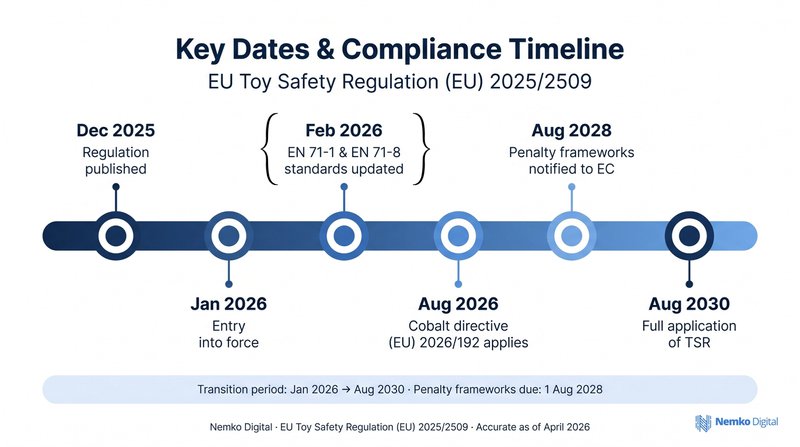
Manufacturers face immediate technical challenges, particularly regarding chemical reformulation and the implementation of the Digital Product Passport. The cobalt directive amendment (2026/192) exemplifies how the regulatory landscape continues to evolve, requiring ongoing attention to compliance updates. Many existing products may not meet the new, stricter limits, requiring extensive supply chain audits and material substitutions. Additionally, developing the data management infrastructure to generate and maintain the DPP will require significant investment . The publication of revised EN71 standards in February 2026 provides manufacturers with the technical specifications needed for compliance, but implementation timelines are tight.
Despite the compliance burden, early adoption offers strategic advantages. Compliance with the new chemical standards and the implementation of the DPP can serve as a powerful market differentiator, allowing brands to position themselves as leaders in child safety and transparency. Robust compliance management systems will also enhance overall supply chain visibility and efficiency, mitigating long-term regulatory and liability risks.
At Nemko Digital, we provide the expertise and tools necessary to navigate these complex regulatory changes. Our comprehensive compliance solutions can help you audit your supply chain, implement the Digital Product Passport, and ensure your products meet the highest safety standards. Partner with us to turn compliance into a competitive advantage.