

.webp)




Anthropic’s survey shows workers most exposed to AI are also most anxious about job loss, even as many report productivity gains. The findings highlight a growing need for upskilling and workforce adaptation.
Higher Exposure Linked to Greater Concern
In its April 22 report, Anthropic said around 20% of respondents expressed concern about economic displacement linked to AI adoption. Users working in highly exposed occupations reported substantially higher anxiety about replacement, with those in the top 25% of exposure mentioning the issue three times more often than users in the bottom 25%—a pattern that aligns with growing public narratives around AI-related job losses.
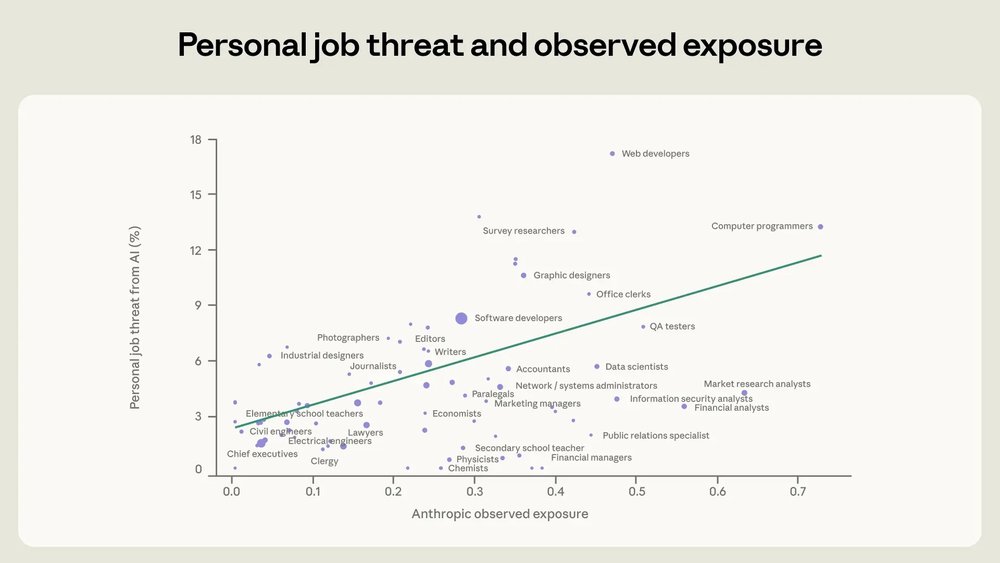
Figure 1: Perceived job threat from AI and Observed Exposure. Percentage of respondents indicating some job threat from AI vs. the Observed Exposure measure from Massenkoff and McCrory (2026). A respondent was coded as indicating job threat if they said their role was already being replaced or substantially reduced, or that such changes were likely in the near term (coded using Claude). The green line shows a simple linear fit.
The report also found that early-career workers were more likely to worry about AI-related disruption than senior professionals. Among the occupations cited, software engineers expressed greater concern than elementary school teachers, suggesting that knowledge-based digital job roles may feel the effects of AI adoption more immediately across the global workforce.
Anthropic further noted a connection between productivity gains and worker anxiety. Respondents who reported the largest efficiency improvements from AI tools were also among those most concerned about long-term job impacts, indicating that the workers benefiting most directly from AI may also feel most vulnerable to automation risks—especially if they lack the organizational support or working knowledge to shift into adjacent responsibilities.
Productivity Gains Extend Beyond Speed
The survey presents a more nuanced picture than a simple automation narrative. Anthropic reported a mean productivity score of 5.1 on a seven-point scale, equivalent to respondents feeling “substantially more productive” when using AI systems.
Importantly, productivity gains were not limited to completing tasks faster. Nearly half of respondents who described productivity improvements said AI helped expand the scope of their work, while 40% emphasized speed-related benefits. Many users reported taking on new responsibilities, building side projects, or experimenting with additional income opportunities through AI-assisted work—often requiring a baseline working knowledge of prompt design, verification, and tool limitations.
The findings suggest AI adoption is changing not only how quickly work is completed, but also what kinds of work individuals can perform. Similar concerns around workforce transformation and skills disruption have also been highlighted in the OECD’s AI and Work research and the World Economic Forum’s Future of Jobs Report 2025. In parallel, some training providers—including specialized programs such as innopharma education—have emphasized rapid upskilling pathways aimed at helping professionals adapt to AI-augmented work.
Businesses Face Workforce and Governance Challenges
Anthropic’s data points to a growing divide between the opportunities created by AI and employee concerns around long-term job security. As organizations integrate AI into everyday operations, the challenge increasingly extends beyond productivity into workforce adaptation, oversight, and governance—especially for firms managing compliance across a distributed, global workforce.
The report also indicates that companies may be shifting from using AI solely for operational efficiency toward broader workplace augmentation. Respondents frequently described AI as a tool for expanding responsibilities and increasing capability rather than simply reducing workloads, reshaping internal expectations for key job roles and performance standards.
That shift arrives as regulatory scrutiny around AI systems continues to increase globally, including under frameworks such as the EU AI Act. Businesses are now facing pressure to balance innovation with transparency, accountability, and workforce impact considerations—an issue increasingly discussed alongside US leadership in AI policy and competitiveness.
Organizations are also increasing focus on AI governance, AI Trust, and broader AI Regulatory Compliance strategies as AI adoption expands across departments and industries. Some organizations are also pulling in empirical insights from adjacent research streams and internal stakeholder reporting to ensure risk, accountability, and finances diversity considerations are addressed alongside productivity.
AI Adoption Continues to Reshape Work
Anthropic’s survey reflects a labour market already adapting to widespread AI integration. While many users report meaningful productivity improvements, the research also shows growing unease among workers in roles most exposed to AI systems, reinforcing concerns about near-term AI-related job losses and the longer-run AI-induced job impact on career stability.
The findings reinforce a broader industry trend: AI adoption is no longer viewed solely as a technology upgrade. Increasingly, it is becoming a workforce, governance, and risk-management issue that organizations must address alongside operational gains—particularly as job design, training, and mobility strategies evolve across the global workforce.