

Ready to elevate your AI product’s trustworthiness and compliance?
Don’t wait - connect with our experts for a free 15-minute consultation call to discuss how our trusted services can help your business thrive in today's competitive landscape.
EU Data Act 2026:
From Compliance Requirements to Implementation
Practical Lessons and Best Practices from EU Data Act Implementations
The EU Data Act is changing how organizations manage data generated by connected products and related services. This replay explains the regulation’s practical implications and how organizations can turn its requirements into an actionable implementation plan.
Nemko Digital AI experts Mónica Fernández and Bas Overtoom cover key Data Act concepts, data access models, and practical requirements such as authentication, machine-readable formats, timely delivery, and clear request processes. The session also highlights key milestones, including the requirement for new connected products to support data access from 12 September 2026, and explores the contractual, technical, and governance changes needed for compliant data sharing.
What You Will Learn
- How to determine whether your connected products, related services, and data sets may be in scope.
- The difference between direct and indirect data-access models, and the organizational and technical controls each may require.
- What a practical data-sharing process should cover, from user authentication and approval to delivery, safeguards, and logging.
- How to approach contract and terms-and-conditions reviews in light of Data Act requirements.
- Why product scoping and a well-maintained data inventory are essential foundations for implementation.
- How to structure a cross-functional roadmap spanning policies, processes, technology, commercial terms, and compliance evidence.
Key Takeaways
- Scope and inventory data. Identify in-scope products, services, and data sets, including trade-secret and personal-data considerations.
- Design for data access. Build data access into new connected products by 12 September 2026.
- Choose an access model. Establish direct or indirect access with appropriate authentication, controls, security, and timely delivery.
- Make data usable. Provide complete, structured, machine-readable formats such as JSON, CSV, or XML, with automated access where feasible.
- Assign cross-functional ownership. Coordinate legal, product, engineering, data, privacy, cybersecurity, and commercial teams.
- Review contracts and terms. Cover access rights, third-party sharing, permitted use, confidentiality, security, personal data, liability, pricing, and evidence.
- Prepare for third-party requests. Define verification, safeguards, documentation, and data-delivery procedures.
- Maintain ongoing compliance. Keep inventories, policies, processes, technical controls, contracts, and evidence updated as products and services evolve.
Ready to move forward with EU Data Act implementation?
Watch the replay to learn how Nemko Digital helps organizations translate EU Data Act requirements into practical action—from identifying connected products and product data in scope to designing data-access arrangements, updating contracts, and building effective governance.
Exclusive opportunity: apply for a complimentary EU Data Act implementation scoping session
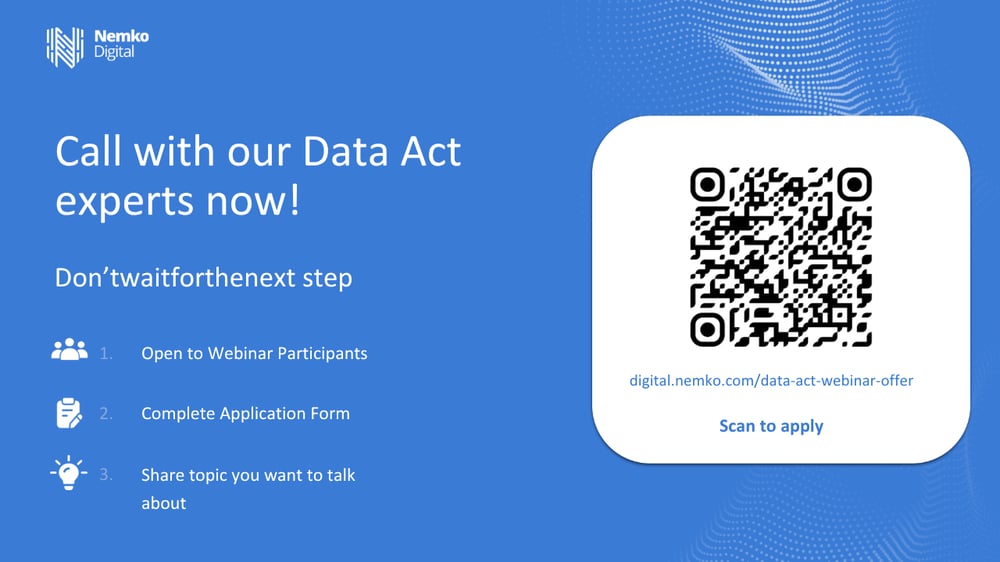
Special Offer: Call with our EU Data Act Experts Now!
Ready to get started? Scan the QR code in the webinar materials or visit the link below to apply for your expert consultation:
CLICK HERE: https://digital.nemko.com/data-act-webinar-offer
Take control of your AI strategy today with Nemko Digital.