
Skip to content
Compliance deadline: December 2027

Is Your Manufacturing Organization Prepared for Cyber Resilience Act Compliance?

The EU Cyber Resilience Act introduces strict, mandatory cybersecurity requirements for all products with digital elements sold in the European Union. With vulnerability reporting requirements taking effect as early as September 2026, the time to assess your readiness is now.
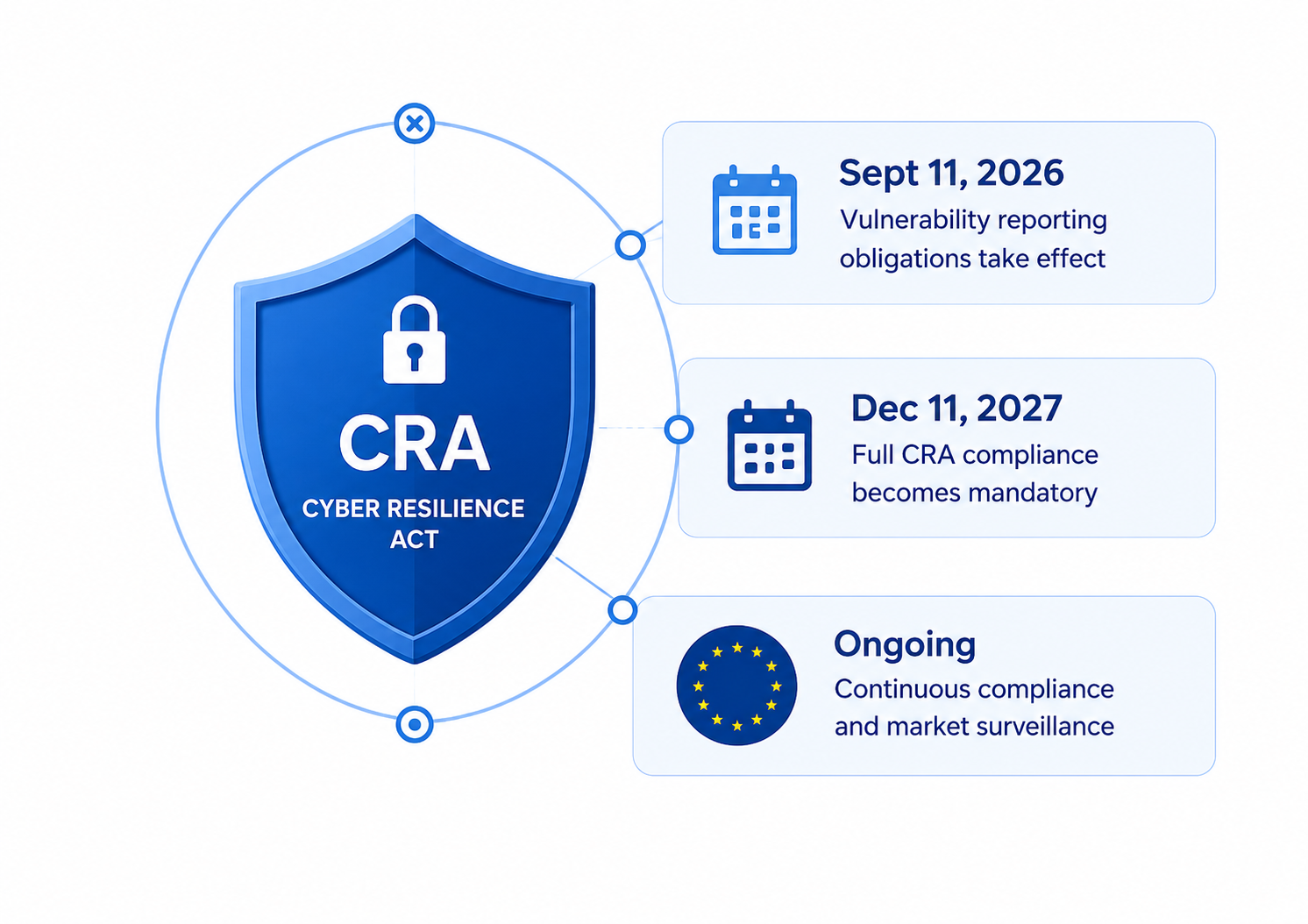
CRA-Timeline-New

What the Cyber Resilience Act Means for Your Organization

The Cyber Resilience Act (CRA) represents the most comprehensive product security regulation introduced by the European Union to date. It is designed to ensure that hardware and software products placed on the EU market have fewer vulnerabilities and that manufacturers remain accountable for security throughout a product's lifecycle.

For manufacturing executives, engineering managers, and product security teams, this regulation necessitates a strategic overhaul of how products are designed, developed, and maintained. Compliance is not merely a legal checkbox; it is a prerequisite for market access. The regulation applies to any product with digital elements—ranging from industrial control systems and sensors to consumer electronics and smart home devices—that connects directly or indirectly to another device or network.

Failing to comply with the CRA carries significant consequences, including restricted access to the EU market, mandatory product recalls, and substantial financial penalties. However, organizations that proactively align with these requirements will not only secure their market position but also build stronger trust with their customers by demonstrating a clear commitment to cybersecurity.

The Business and Operational Impact


Market Access and Competitive Advantage

The European Union is one of the largest markets for digital products. Compliance with the CRA is a non-negotiable requirement for maintaining access to this market. Furthermore, as global cybersecurity standards evolve, early adherence to the CRA positions your organization as a secure, reliable partner, providing a distinct competitive advantage over slower-moving competitors.


Transforming the Development Lifecycle

The CRA mandates "security by design and default." This requires organizations to integrate security considerations into the earliest stages of product architecture and development. Engineering teams must conduct comprehensive cybersecurity risk assessments before a product is placed on the market and ensure that security updates can be deployed automatically whenever technically feasible.


Supply Chain Accountability

Manufacturers are responsible for the security of their products, which includes any third-party components integrated into them. This necessitates greater visibility into your supply chain and stricter security requirements for your vendors. Maintaining a detailed Software Bill of Materials (SBOM) will be essential for tracking and managing vulnerabilities across complex product architectures.

Industry-Specific Challenges for Manufacturers

Implementing the requirements of the Cyber Resilience Act presents specific, practical challenges for the manufacturing industry.

Secure Development Lifecycle Transition

Many manufacturing organizations have historically focused on physical safety and functional reliability, with digital security treated as a secondary concern. Shifting this culture requires substantial training, new tooling, and the integration of security assessments into existing engineering workflows.

Vulnerability Management at Scale

The CRA imposes strict reporting timelines—requiring early warnings for actively exploited vulnerabilities or severe incidents within 24 hours, and full notifications within 72 hours. Establishing the infrastructure and processes necessary to detect, assess, and report these incidents across a global product portfolio is a major operational challenge.

Third-Party Conformity Assessment

For products classified as "critical" (such as industrial routers, firewalls, and certain operating systems), manufacturers must undergo mandatory third-party conformity assessments. Securing capacity with notified bodies and managing the associated costs and timelines will require careful advanced planning.

Key Considerations for CRA Readiness

Product Classification

Determine your product's CRA classification and the applicable conformity assessment procedure, including whether self-assessment or third-party assessment is required.

Security by Design

Evaluate your current engineering processes to ensure cybersecurity risk assessments are conducted and documented prior to market launch.

Vulnerability Management

Assess your capability to generate and maintain accurate Software Bills of Materials (SBOMs) for all products with digital elements.

Incident Reporting

Review your incident response procedures to ensure they can meet the strict 24-hour early warning and 72-hour notification deadlines.

Lifecycle Support

Define clear support periods for your products and provide security updates for at least 5 years or longer where the product's expected lifetime requires it.

Supply Chain Visibility

Implement processes to verify the security posture of third-party components integrated into your final products.

How Organizations Can Prepare Now

The timeline for CRA compliance is fixed, and the preparation phase requires significant lead time. Organizations should begin by conducting a comprehensive gap analysis of their current product portfolio against the CRA requirements. This assessment will help identify which products require immediate attention and which compliance pathways apply.

Following the assessment, establish a cross-functional task force—including engineering, legal, compliance, and product management—to drive the necessary process transformations. Focus on implementing a secure development lifecycle and building the infrastructure required for rapid vulnerability detection and reporting.

Do not wait until the final deadlines approach. The capacity of third-party assessment bodies will be constrained, and the required operational changes take time to embed. The most effective strategy is to start building your compliance framework today.


Download the CRA Compliance Roadmap

Navigating the complexities of the Cyber Resilience Act requires a clear, structured approach. Our comprehensive CRA Compliance Roadmap provides a step-by-step framework to help your organization transition from its current state to full compliance.

  • Practical strategies for classifying your products
  • Step-by-step implementation of security by design
  • Robust vulnerability management processes

An essential tool for executives and engineering leaders who need to translate regulatory requirements into actionable operational plans.

CRA Checklist Cover Mockup (1)

Need Help Preparing for CRA Compliance?

The path to CRA compliance is complex, and you do not have to navigate it alone. Nemko Digital provides specialized expertise to help manufacturing organizations meet the stringent requirements of the Cyber Resilience Act.

Our Services Include:

  • CRA Readiness Assessments
  • Gap Analysis and Remediation Planning
  • Secure Development Lifecycle Implementation Support
  • Product Cybersecurity Advisory

Ensure your organization is prepared for the future of product security.


Book a 15-Minute Consultation